Corporate Newsroom zaczyna się w Twojej głowie
Komunikacja, marketing i sprzedaż wymagają doskonałej organizacji. Mediamoss wspiera Cię w tworzeniu tzw. Corporate Newsroom. Niezależnie od tego, czy pracujesz w średniej wielkości firmie, korporacji czy organizacji pozarządowej, Corporate Newsroom zaczyna się w Twojej głowie, od Twojego podejścia.
Wyjdź z izolacji
Czas przełamać bariery i wyjść z bańki w ramach własnej organizacji. Setki firm w Europie wprowadziły już tzw. Corporate Newsroom do działów marketingu, komunikacji i sprzedaży.
Firmy takie jak Siemens, Hapag-Lloyd, SwissLife czy organizacje jak Holenderska Policja stworzyły ramy organizacyjne dla swoich działań z zakresu marketingu treści. Wykorzystały do tego celu dane i sztuczną inteligencję. Teraz świecą przykładem, jeśli chodzi o przejrzystość komunikacji.

Przełomowy pomysł
Corporate Newsroom to jednostka zajmująca się komunikacją korporacyjną, skupiona w jednym miejscu. Za poszczególne tematy i kanały odpowiadają odrębne zespoły. Koordynacją całości zajmuje się redaktor naczelny.
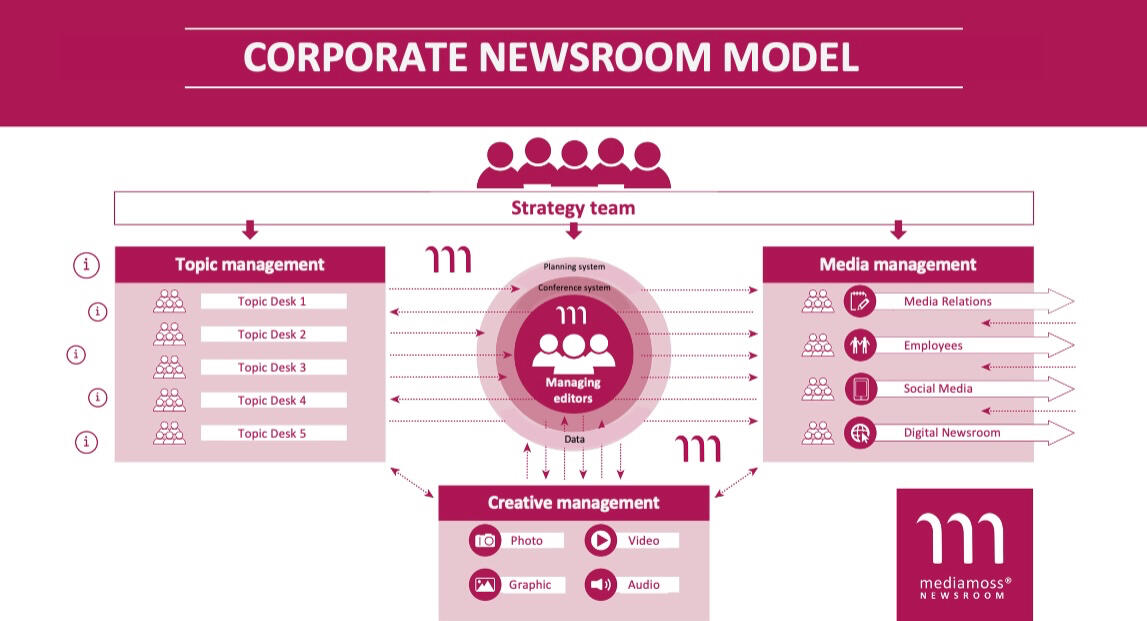
„Newsroom pomaga nam w komunikacji korporacyjnej... Dzięki niemu możemy znacznie precyzyjniej i skuteczniej dotrzeć do naszych grup docelowych i poszczególnych osób”.
Isabel Sabisch, TRILUX
Cyfrowy Newsroom
Media społecznościowe zrewolucjonizowały sposób, w jaki firmy zarządzają swoimi kanałami komunikacji. Dziennikarze, klienci, akcjonariusze, fani i blogerzy – wszystkich łączy wspólne zainteresowanie produktem lub samą firmą. To właśnie skłoniło firmę Porsche do stworzenia cyfrowego newsroomu. Newsroom Porsche jest przeznaczony dla dziennikarzy, blogerów i influencerów internetowych. A także dla wszystkich innych osób zainteresowanych marką.
Skontaktuj się z nami
Czekamy na kontakt.

Prof. Dr. Christoph Moss
Dr. Christoph Moss jest profesorem marketingu i komunikacji na International School of Management w Dortmundzie (Niemcy). Założyciel firmy Mediamoss jest uznawany za eksperta w dziedzinie organizacji redakcji w formie newsroom’u. Profesor Christoph Moss opracował tzw. Corporate Newsroom Model, czyli korporacyjny model organizacji redakcji i wdrożył go już ponad 250 razy – m.in. w takich firmach jak Siemens, Datev i Swiss Life.

Christoph Moss pracował dla stacji telewizyjnych i gazet. Był kierownikiem redakcji w Handelsblatt i kierował Szkołą Dziennikarstwa Gospodarczego im. Georga von Holtzbrincka. Opublikował kilka książek, w tym m.in. „The Corporate Newsroom”.
„Model newsroomu, którego używamy pomaga nam skutecznie komunikować się z osobami zarówno wewnątrz, jak i na zewnątrz organizacji.“
Marco Leeuwerink, Holenderska Policja
© Wszystkie prawa zastrzeżone.
Skontaktuj się z nami
Mediamoss Partner Polska
Presso
Karolina Buczkowska-Maziarka
Kamil Czaplicki
Plac Powstańców Warszawy 2,
00-030 Warszawa, Polska
Mediamoss Newsroom Vienna
AustriaContent Moss & Schwarz GmbH
Ernst-Renz-Gasse 7/3/31
1020 Wien/Austria
Phone: +43 676 3128 777
Mediamoss Newsroom Dortmund
Mediamoss GmbH. Corporate Newsroom Consulting
Joseph-von-Fraunhofer-Straße 20
44227 Dortmund/Germany
Phone: +49 231 286 788 56
Mediamoss Newsroom Stuttgart
Mediamoss GmbH. Stuttgart Office
Neckarstraße 4
70806 Kornwestheim/Germany
Phone: +49 7154 13 05 40
Presso Team Polska


Mediamoss Team Austria i Niemcy












Dział ds. Komunikacji i Marketingu
Model Corporate Newsroom
Branże komunikacji, marketingu i sprzedaży przechodzą radykalne zmiany. Użytkownicy coraz częściej korzystają z mediów, a liczba kanałów gwałtownie rośnie. Dzisiaj każdy może stać się osobą wpływową. Ludzie komentują, publikują treści i zarządzają nimi za pomocą smartfonów. Firmy muszą sprostać zmieniającym się wymaganiom. Powinny w tym celu utworzyć Corporate Newsroom.
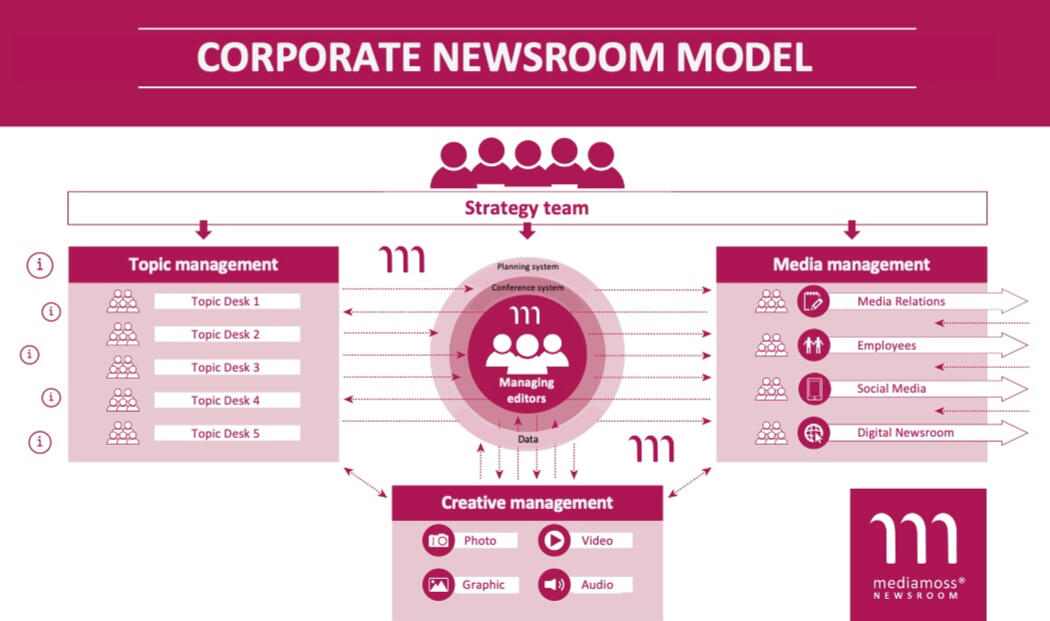
Podstawową ideą stojącą za modelem Corporate Newsroom jest rozdzielenie tematów i kanałów komunikacji. Model ten składa się z czterech poziomów: zespołu ds. strategii, redaktorów zarządzających, zespołu zarządzającego tematami oraz zarządzającego mediami. Możliwe jest również wprowadzenie dodatkowych ról, na przykład w zakresie zarządzania kreatywnego lub analizy danych.
Strategy Team
Zespół ds. strategii stoi na czele Corporate Newsroom. Członkowie zespołu zajmują się komunikacją strategiczną poprzez planowanie, kontrolę i monitorowanie. Wyznaczają oni kierunki merytoryczne dla redaktora naczelnego i zespołów tematycznych. Zespół ma prawo wydawać wytyczne oraz podejmować ostateczne decyzje we wszystkich kwestiach merytorycznych. Zespół ds. strategii jest porównywalny do redaktora naczelnego w redakcjach dziennikarskich. Podobnie jak redaktor naczelny, zespół ds. strategii ponosi również odpowiedzialność za personel i tematy w Corporate Newsroom.
Managing Editors
Redaktorzy zarządzający stanowią ogniwo łączące redakcje tematyczne z kanałami publikacji. Stanowisko to ma kluczowe znaczenie, dlatego powinno być obsadzone przez co najmniej dwie osoby. Redaktorzy mogą pracować na zmianę i zastępować się nawzajem w przypadku urlopu lub choroby. Są informowani o wszystkich tematach i kanałach komunikacji. Wykonują operacyjne zadania komunikacyjne, decydując o znaczeniu poszczególnych tematów. Wydają zlecenia redakcjom tematycznym i medialnym. Redaktorzy zarządzający przewodniczą również kolegiom redakcyjnym. Otrzymują propozycje od redakcji tematycznych i medialnych i mają ostateczną władzę decyzyjną. Wzoruje się to na roli redaktora naczelnego w dziennikarstwie, który koordynuje procesy wewnętrzne. W Corporate Newsroom stanowisko to wiąże się z wysokim ryzykiem konfliktu. Dlatego redaktorzy zarządzający muszą być doświadczonymi profesjonalistami. Z jednej strony, eksperci ci muszą myśleć dziennikarsko i działać zdecydowanie, mając jednocześnie ogląd zarówno na tematy, jak i kanały komunikacji. Z drugiej strony szczegółowa znajomość tematów i mediów nie jest absolutnie konieczna. To zadanie redaktorów zarządzających tematami i redaktorów zarządzających mediami.
Topic Management
W sekcji zajmującej się tematami pracuje co najmniej jeden kierownik ds. tematów. Kierownicy w tym dziale pełnią rolę w dziennikarstwie porównywalną do reporterów. Stanowią łącznik z działami specjalistycznymi firmy. W ten sposób pozyskują szczegółową specjalistyczną wiedzę, dzięki czemu poruszają się merytorycznie sprawnie po tematach wymagających specjalistycznej wiedzy. Redakcja tematyczna regularnie proponuje tematy kierownikom newsroomu. Zajmuje się ona wyszukiwaniem, tworzeniem i redagowaniem treści. Redaktorzy, czy też menedżerowie tematyczni zapewniają niezbędną koordynację z działami specjalistycznymi. Za każdym razem, gdy dział tematyczny dostarcza teksty, zdjęcia lub nagrania dźwiękowe do działu mediów, informuje o tym kierowników newsroomu. Kierownik działu tematycznego bierze udział w kolegiach redakcyjnych.
Działy tematyczne powinny pracować w oparciu o strategię danej marki. Są one ukierunkowane na obszary, w których działa firma. Zadania działów tematycznych można dostosowywać w perspektywie średnioterminowej. Poza niektórymi tematami i projektami, których nie da się zdefiniować i określić z góry. Dlatego w takich przypadkach warto utworzyć zespół projektowy. Wielkość redakcji tematycznej może być zmienna, w zależności od aktualnej liczby zadań. Redaktorzy zarządzający tematami powinni być odpowiedzialni za swoje tematy: proponują nowe tematy kierownikom newsroomu i wprowadzają je do plannera tematów. Menedżerowie tematyczni dostarczają gotowe teksty do zespołu dystrybucji we współpracy z kierownikami newsroomu.
Media Management
Działy mediów reprezentują kanały medialne firmy. Każdy z nich składa się z jednego lub kilku kierowników ds. mediów. Na czele działu mediów stoi kierownik ds. mediów. Ma on prawo proponować redaktorom naczelnym tematy, które jego zdaniem nadają się do danego medium. Kierownik ds. mediów utrzymuje ścisły kontakt z redaktorami naczelnymi i uczestniczy w naradach redakcyjnych. Rola kierownika ds. mediów przypomina rolę redaktora w dziennikarstwie (Moss 1998). Redaktorzy to typowi twórcy stron lub osoby odpowiedzialne za witrynę internetową. To oni decydują, który temat zostanie zaprezentowany w ich medium i jak bardzo jest on istotny. Redagują i śledzą przepływ wiadomości z agencji. Redaktorzy działają jak prawnicy dla czytelnika, użytkownika lub widza. W ten sposób stanowią przeciwwagę dla menedżera ds. tematów i gwarantują zasadę podwójnej kontroli.W Corporate Newsroom zespoły zarządzające mediami śledzą rynek, obserwując dyskusje w mediach społecznościowych lub w mediach tradycyjnych. Działy te są zorganizowane zgodnie z kanałami, z których firma chce korzystać, oraz grupami docelowymi, do których chce się zwracać. Możliwe działy mediów to prasa, internet, media społecznościowe, audio lub wideo. Menedżerowie ds. mediów kontrolują te kanały, w obszarze których mają kompetencje. Wielkość działów mediów zależy od nakładu pracy. Menedżerowie ds. mediów mają prawo proponować redaktorom zarządzającym tematy do swoich kanałów.
Wydajność
Dlaczego warto założyć Corporate Newsroom
Media społecznościowe zrewolucjonizowały sposób, w jaki firmy zarządzają swoimi kanałami komunikacji. Dziennikarze, klienci, akcjonariusze, fani i blogerzy łączą wspólne zainteresowanie produktem lub samą firmą. Pojawienie się tych zróżnicowanych grup skłoniło firmę Porsche do utworzenia cyfrowego newsroomu. Newsroom Porsche jest przeznaczony nie tylko dla dziennikarzy, blogerów i influencerów, ale także dla wszystkich innych osób zainteresowanych marką.
Rosnące zapotrzebowanie na treści medialne w połączeniu z gwałtownym wzrostem liczby kanałów komunikacyjnych oznacza, że przedsiębiorstwa muszą sprostać zmieniającym się wymaganiom w tym zakresie. Obecnie zarówno podmioty wewnętrzne, jak i zewnętrzne związane z daną firmą mogą stać się wpływowymi komunikatorami. Pomożemy Ci dostosować się do obecnych realiów komunikacyjnych.
Dzisiejsze tradycyjne struktury komunikacyjne szybko osiągają swoje granice. Kto ma ochotę dyskutować o tym, co jest ważniejsze: relacje z mediami czy TikTok? Albo marketing czy komunikacja?
Firmy znajdują się pod presją, by jak najskuteczniej kierować swój przekaz, wykorzystując wyłącznie zintegrowaną komunikację, storytelling i marketing treści. Przy ograniczonych zasobach nie można tworzyć nowych kanałów komunikacji w sposób przypadkowy. W tej sytuacji firmy nieuchronnie zaczynają kwestionować strukturę i strategię swojej komunikacji.
Z drugiej strony mogą pojawić się obawy, takie jak strach przed zmianami czy obawy o utratę kontroli. Obawy te można rozwiać jedynie wtedy, gdy wszystkie strony zaangażują się w realizację nowej koncepcji. Jeśli wspólne zaangażowanie nie jest możliwe, firma naraża się na ryzyko obniżenia jakości swoich działań komunikacyjnych z powodu wewnętrznych zasad.
W dłuższej perspektywie komunikację można skutecznie kontrolować tylko wtedy, gdy przedsiębiorstwo stawia w centrum swojej organizacji treść, a nie funkcje, stosując dobrze skonstruowany model komunikacji.Mediamoss wesprze Cię w uruchomieniu korporacyjnego newsroomu – niezależnie od tego, czy będzie to rozwiązanie cyfrowe, czy stacjonarne.Zapraszamy do kontaktu!
Site Notice
Information pursuant to Sect. 5 German Telemedia Act (TMG)Mediamoss GmbH
Joseph-von-Fraunhofer-Straße 20
44227 Dortmund/GermanyCommercial Register: HRB 26192
Registration court: Amtsgericht DortmundRepresented by:Prof. Dr. Christoph Moss
Martin SchwarzContactPhone: +49 (0) 231 286 788 56
E-mail: [email protected]VAT IDSales tax identification number according to Sect. 27 a of the Sales Tax Law: DE292657207Person responsible for editorialProf. Dr. Christoph MossDispute resolution proceedings in front of a consumer arbitration boardWe are not willing or obliged to participate in dispute resolution proceedings in front of a consumer arbitration board.Liability for ContentsAs service providers, we are liable for own contents of these websites according to Paragraph 7, Sect. 1 German Telemedia Act (TMG). However, according to Paragraphs 8 to 10 German Telemedia Act (TMG), service providers are not obligated to permanently monitor submitted or stored information or to search for evidences that indicate illegal activities.Legal obligations to removing information or to blocking the use of information remain unchallenged. In this case, liability is only possible at the time of knowledge about a specific violation of law. Illegal contents will be removed immediately at the time we get knowledge of them.Liability for LinksOur offer includes links to external third-party websites. We have no influence on the contents of those websites, therefore we cannot guarantee for those contents. Providers or administrators of linked websites are always responsible for their own contents.The linked websites had been checked for possible violations of law at the time of the establishment of the link. Illegal contents were not detected at the time of the linking. A permanent monitoring of the contents of linked websites cannot be imposed without reasonable indications that there has been a violation of law. Illegal links will be removed immediately at the time we get knowledge of them.CopyrightContents and compilations published on these websites by the providers are subject to German copyright laws. Reproduction, editing, distribution as well as the use of any kind outside the scope of the copyright law require a written permission of the author or originator. Downloads and copies of these websites are permitted for private use only.The commercial use of our contents without permission of the originator is prohibited.Copyright laws of third parties are respected as long as the contents on these websites do not originate from the provider. Contributions of third parties on this site are indicated as such. However, if you notice any violations of copyright law, please inform us. Such contents will be removed immediately.
Privacy Policy
1. An overview of data protectionGeneral informationThe following information will provide you with an easy to navigate overview of what will happen with your personal data when you visit this website. The term “personal data” comprises all data that can be used to personally identify you. For detailed information about the subject matter of data protection, please consult our Data Protection Declaration, which we have included beneath this copy.Data recording on this websiteWho is the responsible party for the recording of data on this website (i.e. the “controller”)?The data on this website is processed by the operator of the website, whose contact information is available under section “Information Required by Law” on this website.How do we record your data?We collect your data as a result of your sharing of your data with us. This may, for instance be information you enter into our contact form.Other data shall be recorded by our IT systems automatically or after you consent to its recording during your website visit. This data comprises primarily technical information (e.g. web browser, operating system or time the site was accessed). This information is recorded automatically when you access this website.What are the purposes we use your data for?A portion of the information is generated to guarantee the error free provision of the website. Other data may be used to analyse your user patterns.What rights do you have as far as your information is concerned?You have the right to receive information about the source, recipients and purposes of your archived personal data at any time without having to pay a fee for such disclosures. You also have the right to demand that your data are rectified or eradicated. If you have consented to data processing, you have the option to revoke this consent at any time, which shall affect all future data processing. Moreover, you have the right to demand that the processing of your data be restricted under certain circumstances. Furthermore, you have the right to log a complaint with the competent supervising agency.Please do not hesitate to contact us at any time under the address disclosed in section “Information Required by Law” on this website if you have questions about this or any other data protection related issues.Analysis tools and tools provided by third partiesThere is a possibility that your browsing patterns will be statistically analysed when your visit this website. Such analyses are performed primarily with cookies and with what we refer to as analysis programmes.For detailed information about these analysis programmes please consult our Data Protection Declaration below.2. Hosting and Content Delivery Networks (CDN)External HostingThis website is hosted by an external service provider (host). Personal data collected on this website are stored on the servers of the host. These may include, but are not limited to, IP addresses, contact requests, metadata and communications, contract information, contact information, names, web page access, and other data generated through a web site.The host is used for the purpose of fulfilling the contract with our potential and existing customers (Art. 6 para. 1 lit. b GDPR) and in the interest of secure, fast and efficient provision of our online services by a professional provider (Art. 6 para. 1 lit. f GDPR).Our host will only process your data to the extent necessary to fulfil its performance obligations and to follow our instructions with respect to such data.3. General information and mandatory informationData protectionThe operators of this website and its pages take the protection of your personal data very seriously. Hence, we handle your personal data as confidential information and in compliance with the statutory data protection regulations and this Data Protection Declaration.Whenever you use this website, a variety of personal information will be collected. Personal data comprises data that can be used to personally identify you. This Data Protection Declaration explains which data we collect as well as the purposes we use this data for. It also explains how, and for which purpose the information is collected.We herewith advise you that the transmission of data via the Internet (i.e. through e-mail communications) may be prone to security gaps. It is not possible to completely protect data against third party access.Information about the responsible party (referred to as the “controller” in the GDPR)The data processing controller on this website is:Mediamoss GmbH
Joseph-von-Fraunhofer-Straße 20
44227 Dortmund/GermanyPhone: 0231 286 788 56
E-mail: newsroom(at)mediamoss.comThe controller is the natural person or legal entity that single-handedly or jointly with others makes decisions as to the purposes of and resources for the processing of personal data (e.g. names, e-mail addresses, etc.).Revocation of your consent to the processing of dataA wide range of data processing transactions are possible only subject to your express consent. You can also revoke at any time any consent you have already given us. To do so, all you are required to do is sent us an informal notification via e-mail. This shall be without prejudice to the lawfulness of any data collection that occurred prior to your revocation.Right to object to the collection of data in special cases; right to object to direct advertising (Art. 21 GDPR)IN THE EVENT THAT DATA ARE PROCESSED ON THE BASIS OF ART. 6 SECT. 1 LIT. E OR F GDPR, YOU HAVE THE RIGHT TO AT ANY TIME OBJECT TO THE PROCESSING OF YOUR PERSONAL DATA BASED ON GROUNDS ARISING FROM YOUR UNIQUE SITUATION. THIS ALSO APPLIES TO ANY PROFILING BASED ON THESE PROVISIONS. TO DETERMINE THE LEGAL BASIS, ON WHICH ANY PROCESSING OF DATA IS BASED, PLEASE CONSULT THIS DATA PROTECTION DECLARATION. IF YOU LOG AN OBJECTION, WE WILL NO LONGER PROCESS YOUR AFFECTED PERSONAL DATA, UNLESS WE ARE IN A POSITION TO PRESENT COMPELLING PROTECTION WORTHY GROUNDS FOR THE PROCESSING OF YOUR DATA, THAT OUTWEIGH YOUR INTERESTS, RIGHTS AND FREEDOMS OR IF THE PURPOSE OF THE PROCESSING IS THE CLAIMING, EXERCISING OR DEFENCE OF LEGAL ENTITLEMENTS (OBJECTION PURSUANT TO ART. 21 SECT. 1 GDPR).IF YOUR PERSONAL DATA IS BEING PROCESSED IN ORDER TO ENGAGE IN DIRECT ADVERTISING, YOU HAVE THE RIGHT TO AT ANY TIME OBJECT TO THE PROCESSING OF YOUR AFFECTED PERSONAL DATA FOR THE PURPOSES OF SUCH ADVERTISING. THIS ALSO APPLIES TO PROFILING TO THE EXTENT THAT IT IS AFFILIATED WITH SUCH DIRECT ADVERTISING. IF YOU OBJECT, YOUR PERSONAL DATA WILL SUBSEQUENTLY NO LONGER BE USED FOR DIRECT ADVERTISING PURPOSES (OBJECTION PURSUANT TO ART. 21 SECT. 2 GDPR).Right to log a complaint with the competent supervisory agencyIn the event of violations of the GDPR, data subjects are entitled to log a complaint with a supervisory agency, in particular in the member state where they usually maintain their domicile, place of work or at the place where the alleged violation occurred. The right to log a complaint is in effect regardless of any other administrative or court proceedings available as legal recourses.Right to data portabilityYou have the right to demand that we hand over any data we automatically process on the basis of your consent or in order to fulfil a contract be handed over to you or a third party in a commonly used, machine readable format. If you should demand the direct transfer of the data to another controller, this will be done only if it is technically feasible.SSL and/or TLS encryptionFor security reasons and to protect the transmission of confidential content, such as purchase orders or inquiries you submit to us as the website operator, this website uses either an SSL or a TLS encryption programme. You can recognise an encrypted connection by checking whether the address line of the browser switches from “http://” to “https://” and also by the appearance of the lock icon in the browser line.If the SSL or TLS encryption is activated, data you transmit to us cannot be read by third parties.Information about, rectification and eradication of dataWithin the scope of the applicable statutory provisions, you have the right to at any time demand information about your archived personal data, their source and recipients as well as the purpose of the processing of your data. You may also have a right to have your data rectified or eradicated. If you have questions about this subject matter or any other questions about personal data, please do not hesitate to contact us at any time at the address provided in section “Information Required by Law.”Right to demand processing restrictionsYou have the right to demand the imposition of restrictions as far as the processing of your personal data is concerned. To do so, you may contact us at any time at the address provided in section “Information Required by Law.” The right to demand restriction of processing applies in the following cases:In the event that you should dispute the correctness of your data archived by us, we will usually need some time to verify this claim. During the time that this investigation is ongoing, you have the right to demand that we restrict the processing of your personal data.
If the processing of your personal data was/is conducted in an unlawful manner, you have the option to demand the restriction of the processing of your data in lieu of demanding the eradication of this data.
If we do not need your personal data any longer and you need it to exercise, defend or claim legal entitlements, you have the right to demand the restriction of the processing of your personal data instead of its eradication.
If you have raised an objection pursuant to Art. 21 Sect. 1 GDPR, your rights and our rights will have to be weighed against each other. As long as it has not been determined whose interests prevail, you have the right to demand a restriction of the processing of your personal data.
If you have restricted the processing of your personal data, these data – with the exception of their archiving – may be processed only subject to your consent or to claim, exercise or defend legal entitlements or to protect the rights of other natural persons or legal entities or for important public interest reasons cited by the European Union or a member state of the EU.Rejection of unsolicited e-mailsWe herewith object to the use of contact information published in conjunction with the mandatory information to be provided in section “Information Required by Law” to send us promotional and information material that we have not expressly requested. The operators of this website and its pages reserve the express right to take legal action in the event of the unsolicited sending of promotional information, for instance via SPAM messages.4. Recording of data on this websiteCookiesOur websites and pages use what the industry refers to as “cookies.” Cookies are small text files that do not cause any damage to your device. They are either stored temporarily for the duration of a session (session cookies) or they are permanently archived on your device (permanent cookies). Session cookies are automatically deleted once you terminate your visit. Permanent cookies remain archived on your device until you actively delete them or they are automatically eradicated by your web browser.In some cases it is possible that third party cookies are stored on your device once you enter our site (third party cookies). These cookies enable you or us to take advantage of certain services offered by the third party (e.g. cookies for the processing of payment services).Cookies have a variety of functions. Many cookies are technically essential since certain website functions would not work in the absence of the cookies (e.g. the shopping cart function or the display of videos). The purpose of other cookies may be the analysis of user patterns or the display of promotional messages.Cookies, which are required for the performance of electronic communication transactions (required cookies) or for the provision of certain functions you want to use (functional cookies, e.g. for the shopping cart function) or those that are necessary for the optimization of the website (e.g. cookies that provide measurable insights into the web audience), shall be stored on the basis of Art. 6 Sect. 1 lit. f GDPR, unless a different legal basis is cited. The operator of the website has a legitimate interest in the storage of cookies to ensure the technically error free and optimized provision of the operator’s services. If your consent to the storage of the cookies has been requested, the respective cookies are stored exclusively on the basis of the consent obtained (Art. 6 Sect. 1 lit. a GDPR); this consent may be revoked at any time.You have the option to set up your browser in such a manner that you will be notified any time cookies are placed and to permit the acceptance of cookies only in specific cases. You may also exclude the acceptance of cookies in certain cases or in general or activate the delete function for the automatic eradication of cookies when the browser closes. If cookies are deactivated, the functions of this website may be limited.In the event that third party cookies are used or if cookies are used for analytical purposes, we will separately notify you in conjunction with this Data Protection Policy and, if applicable, ask for your consent.Request by e-mail, telephone or faxIf you contact us by e-mail, telephone or fax, your request, including all resulting personal data (name, request) will be stored and processed by us for the purpose of processing your request. We do not pass these data on without your consent.These data are processed on the basis of Art. 6 Sect. 1 lit. b GDPR if your inquiry is related to the fulfillment of a contract or is required for the performance of pre-contractual measures. In all other cases, the data are processed on the basis of our legitimate interest in the effective handling of inquiries submitted to us (Art. 6 Sect. 1 lit. f GDPR) or on the basis of your consent (Art. 6 Sect. 1 lit. a GDPR) if it has been obtained.The data sent by you to us via contact requests remain with us until you request us to delete, revoke your consent to the storage or the purpose for the data storage lapses (e.g. after completion of your request). Mandatory statutory provisions – in particular statutory retention periods – remain unaffected.
5. Analysis tools and advertisingWe use software on our website to evaluate the behaviour of website visitors, known as web analytics or web analysis for short. This involves collecting data that is stored, managed and processed by the respective analytics tool provider (also known as a tracking tool). The data is used to create analyses of user behaviour on our website and made available to us as the website operator. In addition, most tools offer various test options. For example, we can test which offers or content are best received by our visitors. To do this, we show you two different offers for a limited period of time. After the test (known as an A/B test), we know which product or content our website visitors find more interesting. For such test procedures, as well as for other analytics procedures, user profiles can also be created and the data stored in cookies.With our website, we have a clear goal in mind: we want to deliver the best web offering on the market for our industry. In order to achieve this goal, we want to offer the best and most interesting services on the one hand and ensure that you feel completely at ease on our website on the other. With the help of web analysis tools, we can take a closer look at the behaviour of our website visitors and then improve our website accordingly for you and for us. For example, we can recognise the average age of our visitors, where they come from, when our website is visited the most or which content or products are particularly popular. All this information helps us to optimise the website and thus adapt it to your needs, interests and wishes.Exactly which data is stored depends, of course, on the analysis tools used. But as a rule, for example, the content you view on our website, which buttons or links you click on, when you call up a page, which browser you use, which device (PC, tablet, smartphone, etc.) you use to visit the website or which computer system you use is stored. If you have agreed that location data may also be collected, this may also be processed by the web analysis tool provider.Your IP address is also stored. According to the General Data Protection Regulation (GDPR), IP addresses are personal data. However, your IP address is usually stored pseudonymised (i.e. in an unrecognisable and shortened form). For the purposes of testing, web analysis and web optimisation, no direct data such as your name, age, address or email address is stored. All this data, if collected, is stored in pseudonymised form. This means that you cannot be identified as a person. How long the respective data is stored always depends on the provider. Some cookies only store data for a few minutes or until you leave the website, while other cookies can store data for several years.We will inform you about the duration of data processing below if we have further information on this. In general, we only process personal data for as long as is absolutely necessary for the provision of our services and products. If required by law, for example in the case of accounting, this storage period may be exceeded.The use of web analytics requires your consent, which we have obtained with our cookie pop-up. According to Art. 6 para. 1 lit. a GDPR (consent), this consent constitutes the legal basis for the processing of personal data, as may occur when it is collected by web analytics tools. In addition to consent, we have a legitimate interest in analysing the behaviour of website visitors in order to improve our website technically and economically. With the help of web analytics, we recognise errors on the website, can identify attacks and improve efficiency. The legal basis for this is Art. 6 para. 1 lit. f GDPR (legitimate interests). Nevertheless, we only use the tools if you have given your consent.
Since web analytics tools use cookies, we recommend that you also read our general privacy policy on cookies. To find out exactly which of your data is stored and processed, you should read the privacy policies of the respective tools. Information on specific web analytics tools, if available, can be found in the following sections.Google Analytics privacy policyWe use the analysis tracking tool Google Analytics (GA) of the American company Google Inc. on our website. For the European area, the company Google Ireland Limited (Gordon House, Barrow Street Dublin 4, Ireland) is responsible for all Google services. Google Analytics collects data about your actions on our website. For example, when you click on a link, this action is stored in a cookie and sent to Google Analytics. The reports we receive from Google Analytics enable us to better customise our website and our service to your wishes. In the following, we will go into more detail about the tracking tool and inform you in particular about what data is stored and how you can prevent this.
Google Analytics is a tracking tool used to analyse traffic on our website. For Google Analytics to work, a tracking code is integrated into the code of our website. When you visit our website, this code records various actions that you perform on our website. As soon as you leave our website, this data is sent to the Google Analytics servers and stored there.Google processes the data and we receive reports on your user behaviour. These may include the following reports:
- Target group reports: We use target group reports to get to know our users better and know more precisely who is interested in our service.
- Display reports: Display reports make it easier for us to analyse and improve our online advertising.
- Acquisition reports: Acquisition reports provide us with helpful information on how we can get more people interested in our service.
- Behavioural reports: This tells us how you interact with our website. We can see which path you take on our site and which links you click on.
- Conversion reports: Conversion is a process in which you perform a desired action as a result of a marketing message. For example, when you convert from a mere website visitor to a buyer or newsletter subscriber. With the help of these reports, we learn more about how our marketing measures are received by you. This is how we want to increase our conversion rate.
- Real-time reports: Here we always know immediately what is happening on our website. For example, we can see how many users are currently reading this text.
Why do we use Google Analytics on our website?
Our goal with this website is clear: we want to offer you the best possible service.The statistics and data from Google Analytics help us to achieve this goal.The statistically analysed data gives us a clear picture of the strengths and weaknesses of our website. On the one hand, we can optimise our site so that it can be found more easily by interested people on Google. On the other hand, the data helps us to better understand you as a visitor. We therefore know exactly what we need to improve on our website in order to offer you the best possible service.The data also helps us to carry out our advertising and marketing measures more individually and cost-effectively. After all, it only makes sense to show our products and services to people who are interested in them.
What data is stored by Google Analytics?
Google Analytics uses a tracking code to create a random, unique ID that is linked to your browser cookie.This is how Google Analytics recognises you as a new user. The next time you visit our site, you will be recognised as a ‘returning’ user.All collected data is stored together with this user ID.
This is what makes it possible to analyse pseudonymous user profiles in the first place.In order to be able to analyse our website with Google Analytics, a property ID must be inserted into the tracking code.The data is then saved in the corresponding property. The Google Analytics 4 property is standard for every newly created property.Alternatively, you can also create the Universal Analytics property.Depending on the property used, data is stored for different lengths of time.
Your interactions on our website are measured using identifiers such as cookies and app instance IDs.Interactions are all types of actions that you perform on our website.If you also use other Google systems (such as a Google account), data generated via Google Analytics may be linked to third-party cookies. Google does not pass on any Google Analytics data unless we as the website operator authorise this. Exceptions may be made if required by law.6. Plug-ins and ToolsYouTube with expanded data protection integrationOur website embeds videos of the website YouTube. The website operator is Google Ireland Limited (“Google”), Gordon House, Barrow Street, Dublin 4, Ireland.We use YouTube in the expanded data protection mode. According to YouTube, this mode ensures that YouTube does not store any information about visitors to this website before they watch the video. Nevertheless, this does not necessarily mean that the sharing of data with YouTube partners can be ruled out as a result of the expanded data protection mode. For instance, regardless of whether you are watching a video, YouTube will always establish a connection with the Google DoubleClick network.As soon as you start to play a YouTube video on this website, a connection to YouTube’s servers will be established. As a result, the YouTube server will be notified, which of our pages you have visited. If you are logged into your YouTube account while you visit our site, you enable YouTube to directly allocate your browsing patterns to your personal profile. You have the option to prevent this by logging out of your YouTube account.Furthermore, after you have started to play a video, YouTube will be able to place various cookies on your device. With the assistance of these cookies, YouTube will be able to obtain information about our website’s visitors. Among other things, this information will be used to generate video statistics with the aim of improving the user friendliness of the site and to prevent attempts to commit fraud. These cookies will stay on your device until you delete them.Under certain circumstances, additional data processing transactions may be triggered after you have started to play a YouTube video, which are beyond our control.The use of YouTube is based on our interest in presenting our online content in an appealing manner. Pursuant to Art. 6 Sect. 1 lit. f GDPR, this is a legitimate interest. If a corresponding agreement has been requested, the processing takes place exclusively on the basis of Art. 6 para. 1 lit. a GDPR; the agreement can be revoked at any time.For more information on how YouTube handles user data, please consult the YouTube Data Privacy Policy under: https://policies.google.com/privacy?hl=en.